
Why the Backward Sacada Does More Harm Than Good
There’s this one figure in tango that suddenly makes people’s eyes light up. Leaders out of excitement. Followers already anticipating the pain. And the moment it shows up in class, everyone wants to learn it.
The backward sacada.
It sounds fancy. It feels “advanced.” And that’s exactly where the problem begins.
Because while many are still struggling to simply stand in balance, pivot cleanly, or lead clearly at all, suddenly they’re learning a figure that doesn’t even work reliably for professionals (you’d be surprised how often this thing goes wrong).
Why the Backward Sacada Is So Popular – And That’s Exactly the Problem
The backward sacada has an image problem. Or rather: an image it doesn’t deserve.
It looks complex, spectacular, somehow “level 10.”
And that’s exactly why everyone wants to dance it. To feel like the biggest deal on the dance floor.
A total show off move, if you ask me. And not in a classy “I wear a Rolex” kind of way, more like a “eh, yeah, look at my BMW, bro” kind of energy.
Let’s be honest for a second: Since when is “difficult” or “potentially dangerous” a sign of quality in tango?
No follower has ever said after a tanda: “Wow, I love dancing with him, he leads such complicated figures I don’t understand at all.”
Not once. Not a single woman. What followers actually say is: “He leads so clearly, I feel like I understand everything.”, “Such a beautiful embrace.”, “So musical.”
That’s the difference between making an impression and leaving one.
The Real Problem: Risk Instead of Connection
Let’s look at what actually happens in a backward sacada: Someone steps backward into the other person’s space. The timing has to be perfect. The axis has to be stable. The communication has to be crystal clear.
Now here’s reality:
Even professionals mess this up sometimes. And when it goes wrong, it’s not just a harmless “oops.” It’s heel meets shin. Pain. Bruises. Sometimes worse. And most of all: a loss of trust.
In plain terms: You’re dancing a figure where mistakes physically hurt your partner. In a social dance setting. On a crowded floor. With a follower who cannot defend herself in that moment.
Suddenly not so sexy anymore, right?
The Hidden Effect: A Split Second of Panic
There’s something else nobody really talks about. Followers who know this figure recognize it. And they recognize it early.
That tiny moment of: “Oh… backward sacada… oh no. Please don’t hit me.”. That’s not connection. That’s tension.
And even if everything works out in the end, something is lost: That moment of surrender. That feeling of “I can just relax into this dance.”
One single step and the connection is gone.
And Then There’s the Embrace
Let’s think about this practically: To execute a backward sacada, you have to twist your body in a way that allows you to step backward into your partner.
So the question is: Where exactly is “heart to heart” (“corazón a corazón”) in that moment?
Answer: gone. Anatomically impossible. What’s left is a flashy move, but no connection.
And tango without connection is well just steps. Great.
Why This Belongs on Stage – Not in the Milonga
Some things look impressive. Some things feel good.
The backward sacada often doesn’t even fully belong to the first category.
There are movements that exist for a reason on stage or in shows and not on a social dance floor.
Like jumps or big show figures.
On stage: great.
In social tango: unnecessary risk.
As a leader, you carry responsibility for your partner. And choosing a step that might hurt them that shouldn’t even be an option.
What Actually Matters (And Will Make You Better Instantly)
If you really want to become a better dancer, you don’t need the backward sacada.
You need:
- a stable axis
- clear leading
- a relaxed, honest embrace
- musicality
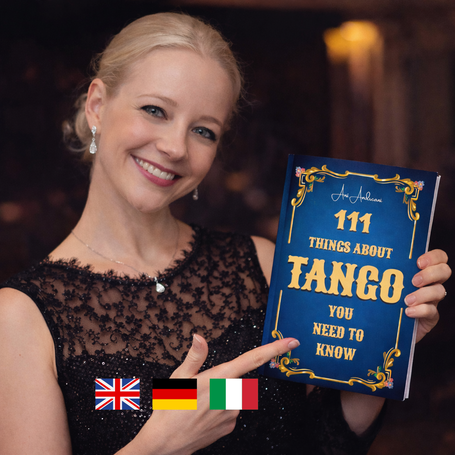
These are the things that make people want to dance with you. Not a figure. And this is exactly the kind of perspective I keep coming back to also in my book “111 Things You Should Know About Tango.”
(available on amazon in English, German and Italian)
The backward sacada doesn’t exactly come out looking great there either for good reason.
A Quick Thought for Teachers
And if you’re reading this as a teacher:
Maybe teaching isn’t about showing everything you can do but about what actually makes sense for your students. Complex figures like the backward sacada may sound impressive. But if the basics aren’t there yet, they don’t help anyone.
Quite the opposite:
They distract from what really matters. And that’s exactly what we should be giving our students.
So: Just Leave It Out
The backward sacada isn’t forbidden. But in most cases, it’s simply unnecessary. And often even risky.
If one day you can execute it safely, consciously, and with full control, fine, take it to the stage.
But keep it out of social dancing. Otherwise we’re entering the category of socially questionable tango.
Trust me on this: You’re not missing out. You’ll gain much more by focusing on what tango is really about:
Connection
Feeling
Communication
A Final Thought
Next time you dance, don’t ask yourself: “What figure can I add?”
Ask instead: “How does this feel for my partner?”
That’s the moment your tango actually becomes good.
Or, put differently:
You can keep trying to impress with complicated, unnecessary figures.
Or you can learn to dance in a way that feels light, clear, and deeply connected for your partner.
If you want the second option, take a look at my private lesson bundles: